From Creek Nation to a City on the Rise: The History and Exciting Future of Broken Arrow, Oklahoma
Broken Arrow is a city where the past and future seem to meet on Main Street.
Today, nearly 125,000 people call Broken Arrow home. New neighborhoods continue to grow, businesses are arriving and expanding, roads and public facilities are being improved, downtown is preparing for its next chapter, and a major entertainment venue promises to bring thousands of visitors to the community.
But long before Broken Arrow became one of Oklahoma's largest cities, its story began with the Muscogee people.
And understanding that story makes what is happening in Broken Arrow today even more remarkable.
Broken Arrow's Story Began Before Oklahoma
The name Broken Arrow did not originate with the modern city.
The area's first permanent residents were members of the Muscogee (Creek) Nation who were forcibly removed from their homelands in the southeastern United States during the 1800s.
According to Museum Broken Arrow, the people who settled along the Arkansas River were members of the Thlikachka, or Broken Arrow tribal town, whose original town had been located along the Chattahoochee River in Alabama. Some arrived in what is now the Broken Arrow area as early as 1828.
The origin of the Broken Arrow name itself is fascinating.
Museum Broken Arrow explains that the Broken Arrow group had separated from the larger Coweta tribal town. The name was associated with people who gathered river cane and bois d'arc limbs used in making arrows, breaking or snapping the materials as they collected them.
The Muscogee established farms and homes across portions of what is now southern Broken Arrow. The fertile Arkansas River bottoms supported crops including corn, beans, squash, melons and pumpkins.
Reminders of this history remain.
White Church, established in 1875, became an early church and school in the area. The McHenry Cemetery contains the grave of James McHenry, an important Muscogee leader who helped draft the Creek National Constitution and is credited with founding Broken Arrow Indian Methodist Church in 1874.
Broken Arrow's history, in other words, did not begin when Oklahoma became a state.
It reaches considerably further back.
Then Came the Railroad
The next transformation came around the turn of the 20th century.
Coal mining began in the area around 1901. A nearby settlement called Elam developed, complete with homes and a cotton gin, while its founders anticipated the arrival of a railroad.
There was one problem.
The railroad did not go where they expected.
So residents did something that sounds almost unbelievable today: many buildings were placed on runners and moved to the new railroad townsite, pulled by teams of horses and steam-powered tractors.
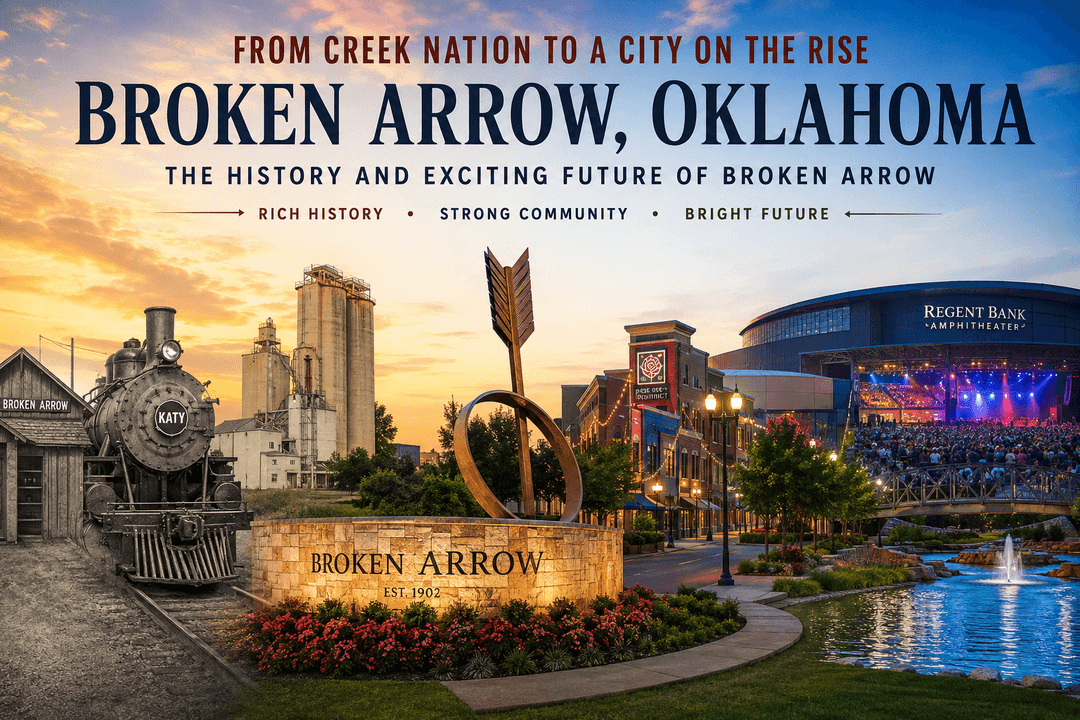
In 1902, the Missouri-Kansas-Texas Railroad, better known as the Katy Railroad, announced its new line.
A townsite was selected and named Broken Arrow after the Muscogee community already associated with the area.
The modern Broken Arrow had arrived.
For several years it was Broken Arrow, Indian Territory. Oklahoma would not achieve statehood until 1907.
Agriculture, Coal and a Growing Main Street
Broken Arrow developed as an agricultural and commercial center.
Cotton played an important role, as did coal.
In fact, Museum Broken Arrow reports that in 1934 Broken Arrow shipped more railroad cars of coal than any other Oklahoma city. Strip mining continued east of the community until after World War II.
Another Broken Arrow tradition was born from agriculture.
What began as an effort to help farmers sell excess roosters eventually became Rooster Days. The first event moved roughly 5,000 pounds of roosters, and the celebration expanded into a community-wide event.
Today, Museum Broken Arrow describes Rooster Days as Oklahoma's longest-running festival.
Meanwhile, Main Street became the commercial heart of the community.
During its mid-20th-century heyday, downtown contained movie theaters, banks, grocery stores, clothing shops, jewelers, drugstores, professional offices, an ice cream parlor and numerous other businesses.
Broken Arrow was becoming a city.
The Road That Changed Broken Arrow
One of the most consequential developments came during the 1950s and 1960s.
Planning began for the Broken Arrow Expressway in 1955.
When it opened a decade later, the highway made commuting between Broken Arrow and Tulsa substantially easier and helped accelerate Broken Arrow's growth.
What had been a relatively small agricultural and railroad community increasingly became part of a growing metropolitan economy.
And Broken Arrow kept expanding.
Northeastern State University opened its Broken Arrow campus in 2001. The Creek Turnpike opened through Broken Arrow in 2002. Bass Pro Shops followed in 2005, and the Broken Arrow Performing Arts Center opened in 2009.
Those developments helped reshape where people lived, worked, studied, shopped and spent their leisure time.
But another transformation was happening back where the city began.
Main Street Comes Back to Life
Like downtown districts across America, Broken Arrow's historic commercial core experienced difficult decades as development moved elsewhere.
City leaders eventually made a major bet on downtown.
The original 2005 Downtown Master Plan helped lay the groundwork for what would become the Rose District. In 2012, the city formally adopted the Rose District name for its arts and entertainment district.
The name itself reaches into another chapter of Broken Arrow history.
Early residents planted roses, trees and flowers to beautify what had been relatively sparse prairie. Roses became so associated with the community that travelers once nicknamed Broken Arrow the "City of Roses."
That heritage returned to Main Street.
Public and private investment created wider sidewalks, landscaping, outdoor dining areas and pedestrian-friendly spaces. Restaurants, boutiques, entertainment and community events helped transform downtown back into a destination.
The Rose District became an example of something Broken Arrow has repeatedly done throughout its history:
Reinvent itself without completely abandoning what came before.
Broken Arrow Today
The scale of today's city would probably be difficult for Broken Arrow's early residents to imagine.
The City estimates the population at 124,991, spread across approximately 60 square miles. Between the 2010 and 2020 censuses, Broken Arrow grew 14.8 percent.
Broken Arrow is not simply a bedroom community, either.
The city says it contains Oklahoma's third-largest manufacturing hub, while economic-development efforts continue to focus on attracting primary jobs, retaining existing employers, developing the workforce and expanding retail and tourism.
And now another major period of investment is underway.
The Next Broken Arrow Is Already Being Built
In April 2026, voters approved all seven propositions in Broken Arrow's Build Our Future BA general-obligation bond package.
Together, those propositions authorize approximately $415 million in capital improvements involving transportation, public safety, quality of life, public facilities, stormwater, drainage and a library partnership.
The transportation program alone includes improvements along major Broken Arrow corridors such as Tucson, Omaha, New Orleans, Olive, Houston, Elm, Florence, Kenosha, County Line and Aspen.
This is not merely about accommodating today's traffic.
It is infrastructure being built for the Broken Arrow of tomorrow.
A New Chapter for Downtown
Even the successful Rose District is not considered finished.
In 2026, Broken Arrow began developing a new Downtown Master Plan, building upon the original plan that helped produce the Rose District.
The study encompasses more than two square miles along the Main Street corridor and is examining economic development, transportation, public spaces, infrastructure, housing and quality of life.
The planning process is expected to take roughly a year.
That means the next evolution of downtown Broken Arrow is being considered right now.
The question is no longer simply how to revitalize Main Street.
What should downtown Broken Arrow become over the next generation?
A Major Entertainment Destination
Perhaps the most visible symbol of Broken Arrow's next chapter is rising in east Broken Arrow.
The city's Events Park reopened in April 2026 after extensive infrastructure work associated with the new amphitheater development. Improvements included roads, parking, walking paths, landscaping, lighting, a pedestrian bridge and a new Creek Turnpike on-ramp.
The venue, now known as the Regent Bank Amphitheater, represents an investment of more than $100 million and is designed for year-round performances.
The city has cited an estimated $211 million annual economic impact associated with the project.
The 12,500-seat venue is expected to become one of the most significant entertainment destinations in the region.
If the project performs anywhere near expectations, its effect could extend well beyond concerts.
Visitors need restaurants.
They stay in hotels.
They buy gasoline.
They shop.
They discover other businesses.
And some of them return.
That creates opportunities for entrepreneurs throughout Broken Arrow.
Growth Brings Decisions, Too
An exciting future does not mean every proposed development is automatically right for the community.
Broken Arrow demonstrated that in 2026 when a prospective company explored acquiring land for a possible data center in east Broken Arrow.
The company's purchase agreement ultimately expired, and the project did not proceed. The City Council subsequently approved a six-month moratorium while officials study the potential impacts of future data-center developments.
That is an important part of Broken Arrow's next chapter as well.
Growth inevitably creates questions about infrastructure, water, power, traffic, land use, neighborhoods and quality of life.
The challenge is not merely to grow.
It is to grow well.
A City Still Writing Its Story
Broken Arrow has already been many things.
It has been a Muscogee community.
A railroad town.
An agricultural center.
A coal-mining community.
A Main Street shopping town.
A Tulsa suburb.
A manufacturing center.
And increasingly, it is becoming a destination of its own.
That is what makes Broken Arrow's future particularly interesting.
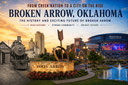
The same community where buildings were once physically hauled to a railroad townsite now contains nearly 125,000 residents. The Main Street that declined decades ago has become the Rose District. A community once connected to the outside world by the Katy Railroad now sits along highways and turnpikes while preparing to welcome thousands of concertgoers to a major entertainment venue.
Yet traces of every earlier Broken Arrow remain.
The railroad.
The grain silo.
The historic buildings.
The Rose District.
White Church.
Rooster Days.
The Museum Broken Arrow.
The Muscogee history behind the city's very name.
Broken Arrow's story has never really been about standing still.
It has been about building what comes next.
And perhaps that is the most exciting part of living here today:
The next chapter is not history yet. We are watching it happen.
BrokenArrow.app connects residents with local businesses, events, deals, community information and everything happening across Broken Arrow, Oklahoma.